

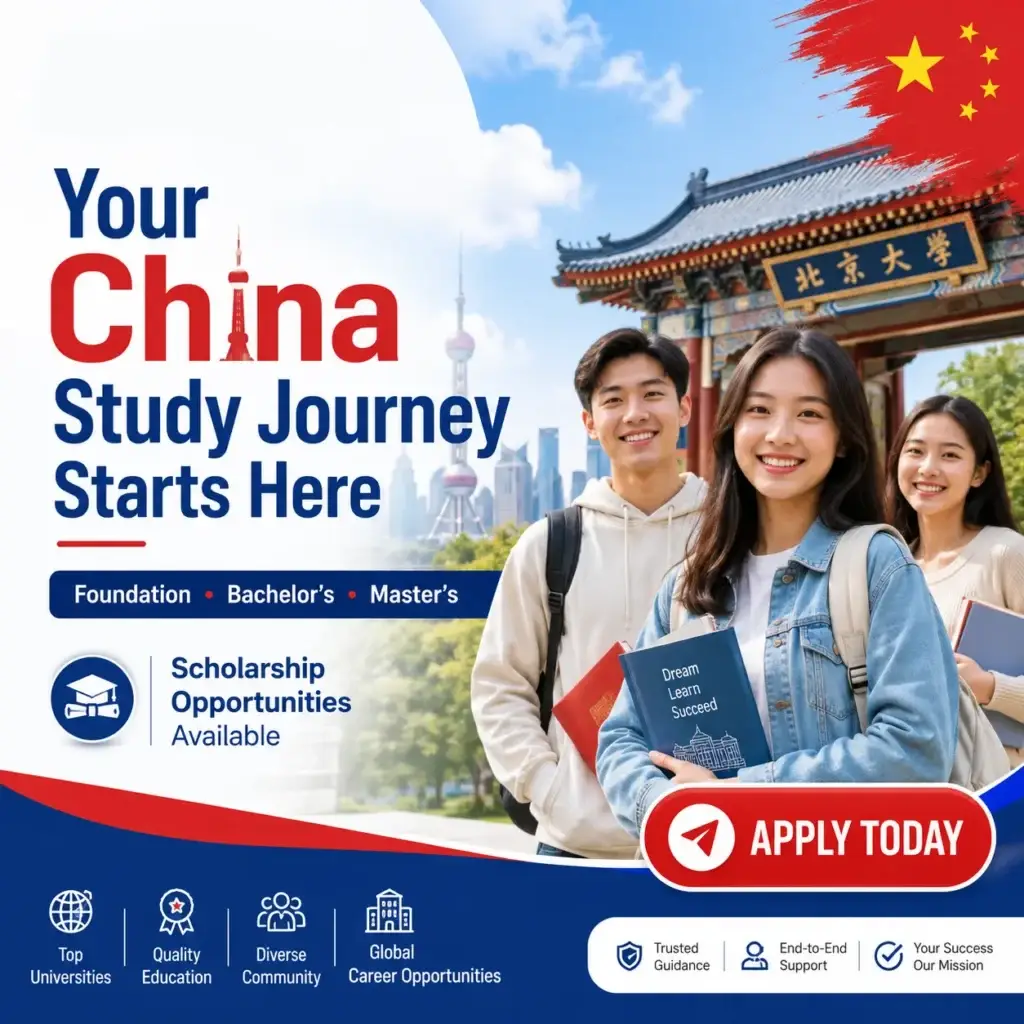
Study in China from Bangladesh
China has become an important higher education destination for Bangladeshi students seeking affordable degree programmes, scholarships and opportunities to study at large research universities.
Students can pursue bachelor’s, master’s and doctoral programmes in subjects including engineering, medicine, business, computer science, international relations, economics and Chinese language.
A number of programmes are available to international students in English, while Chinese-taught programmes may require appropriate Chinese-language proficiency.
Overview of Studying in China from Bangladesh
China has a large higher education system that includes comprehensive universities, science and technology universities, medical universities and specialised institutions.
For Bangladeshi students, China can be particularly attractive because of scholarship opportunities and the relatively broad selection of programmes and institutions.
The China Scholarship Council, under the Ministry of Education, administers Chinese Government Scholarship programmes.
Why study in China from Bangladesh?
China offers students access to rapidly developing areas such as technology, engineering, artificial intelligence, manufacturing, medicine and scientific research.
Tuition and living costs can also be competitive compared with many Western study destinations.
Another significant attraction is scholarship availability through the Chinese Government and individual universities.

Benefits of Studying in China
International students can experience a major global economy while completing their education.
Many universities provide laboratories, research centres, international student accommodation, campus facilities and Chinese-language learning opportunities.
Students may also gain exposure to China’s technology, engineering and manufacturing sectors.
| Course | Description | Typical Duration | Estimated Tuition Fee |
|---|---|---|---|
| Engineering | Civil, electrical, mechanical, chemical and other engineering disciplines. | 4 years | Approx. RMB 20,000–45,000/year |
| Computer Science & AI | Computer engineering, software, AI, data science and related technology programmes. | 4 years | Approx. RMB 20,000–45,000/year |
| Business & Economics | International business, economics, finance and management. | 4 years | Approx. RMB 18,000–40,000/year |
| Medicine / MBBS | Medical education with clinical components. Programme recognition should be verified before applying. | Around 6 years | Approx. RMB 30,000–60,000/year |
| Chinese Language | Mandarin language training and Chinese cultural studies. | 1–4 years | Approx. RMB 15,000–35,000/year |

Book A Consulting
Fill up the following form to get assessed for up to 70% scholarship.

Popular Courses for Bangladeshi Students
Engineering and technology are particularly popular, alongside computer science, artificial intelligence, business, economics, medicine, international trade and Chinese language.
Students considering medicine should carefully verify programme recognition and licensing requirements in Bangladesh or any other country where they plan to practise.
Chinese Universities and Institutions
China has comprehensive universities as well as institutions specialising in medicine, engineering, science, business and other disciplines.
Students should consider programme recognition, teaching language, location, scholarship conditions, accommodation and total costs rather than selecting a university based solely on ranking.
Scholarships for Bangladeshi Students:
The Chinese Government Scholarship is one of the best-known funding routes.
Government scholarship funding may include tuition and other forms of support depending on the particular scholarship category and programme. Universities may also provide their own partial or full scholarships.
Applicants should confirm current eligibility, deadlines and application routes before submitting documents.

China Student Visa Process
Students studying for more than 180 days generally require an X1 visa, while the X2 visa applies to study of no more than 180 days.
For X1 applications, students normally need the admission documentation and relevant study-in-China documentation. X1 holders are required to apply for an appropriate residence permit after entering China.
Bangladeshi ordinary-passport applications are handled through the Chinese Visa Application Service Center arrangements in Dhaka.
Start Your Study Journey in China
Students should first determine the programme, language of instruction, budget and whether they intend to apply as self-funded or scholarship students.
Akif Consulting Firm can assist with university selection, programme comparison, scholarship guidance, admission documentation and student visa preparation.
Study in China Guidance FAQ
Is China good for Bangladeshi students?
It can be an attractive option for students seeking relatively affordable education and scholarship opportunities.
What is the X2 visa?
It generally covers study lasting no more than 180 days.
Can I study in English?
Many institutions offer selected programmes in English, although availability depends on university and subject.
How long is MBBS?
China’s standards for approved English-medium undergraduate medical education for international students specify six years.
Is IELTS required?
It depends on the university, programme and language of instruction.
How do I apply from Bangladesh?
Choose your programme and institution, prepare admission documentation, complete the university application, obtain the required admission documents and then complete the appropriate student visa process.
What is the X1 visa?
It is the visa category generally used for study lasting more than 180 days.
Are scholarships available?
Yes. Chinese Government Scholarships and university scholarships are available.
Can I study MBBS?
Yes, but students should verify the university, programme recognition and professional licensing requirements before applying.
Can international students work in China?
Off-campus work or internships are regulated. Students holding study residence permits generally need the required institutional approval and residence-permit endorsement before undertaking authorised off-campus work or internships.
Can I apply with a study gap?
Possibly, subject to university requirements.